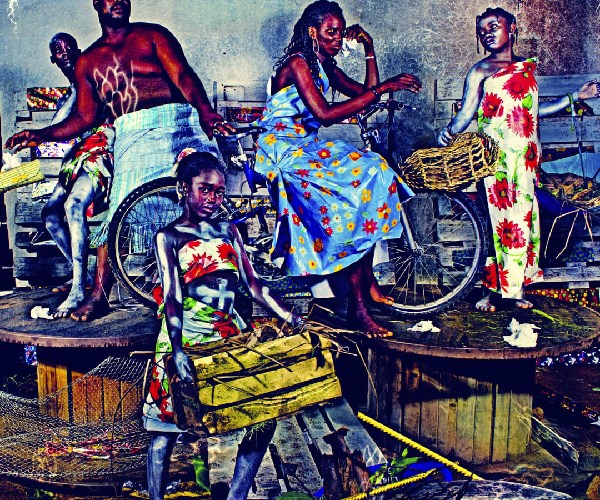
Paul Sika's True Colors

Paul Sika’s True Colors

Paul Sika’s art somehow manages to touch the deepest part of my soul; the vibrant colors in his work seem enhanced and unrealistic, yet, for me, they’re a true representation of all that Africa is – colorful, energetic and alive…

The artist smiles as he recounts more than one time when a friend in high school tried to convince him to join the photography club. He was not interested and could not be convinced. Today, at just 28, he is an ‘Ivorian phenomenon’ hailed by CNN as ‘no ordinary photographer’ and recognized worldwide by the likes of high- profilers like Kanye West. In fact, in 2009, West featured Sika (who was 24 at the time) on his blog for his artworks of ‘Africa in Technicolor’.

The shift in the direction of Sika’s life occurred while studying software engineering at the University of Westminster in the United Kingdom. After seeing a trailer of the Matrix 2: Reloaded, a desire to become a director of great films started to grow in the back of his mind, and in his heart.

“As I was studying software engineering and did not want to jeopardize my studies, I opted for acquiring a photo camera as I viewed the static photo as being the unit of the moving picture”.

His plan was to experiment with photography and enter film school once he had completed his studies. While experimenting, however, his vision of the medium grew wider and clearer and he began to recognize it as a repository of infinite possibilities and dimensions of imagination. With this new reality, it was easier for him to see how the movie director’s mind worked and he naturally developed a cinematic, theatrical style of imaging. This led to the concept of ‘photomaking’ – the name Sika gave to his vision and style of art that he describes as the fusion of PHOTOgraphy and filmMAKING. The process involves all the elements of film and photography, including; imagination, script, cast, rehearsal, principal photography and postproduction.

True to his idea of ‘photomaking’, Sika also uses the manipulation of color to create a unique identity for his art.

“In a busy world where we are always moving (fast) and are constantly bombarded by visual, audio and other sensory stimuli, colors act as shouters to the mind and work to naturally create the fraction of silence in the observer necessary to start the conversation”.

His use of bright, bold colors reflects the vibrancy and energy of the African continent portrayed in his works and carries an underlying social narrative that challenges people’s beliefs about his homeland. He believes that, through color, his work takes on a ‘non-miserabilist’ representation of the supposedly ‘Dark Continent’.

At such a young age Sika clearly has a mature outlook on life.

“If there is one thing I do not want to depart the world without doing, it is to find the meaning of life. As an artist gives what he has and shares what he lives, my work is ridden with the search for the meaning of life”.

In his latest release, the second edition book of his ‘At the Heart of Me’ collection (currently the number one selling African art book on Amazon.com), he explores, among other things, the themes of; the search for the perfect love, the growth of the youth, the overcoming of obstacles, the definition of the self, the path of the artist, the illusions of life, the meaning of being an African and the concept of the African dream. His vision for the book is for it to serve Africa and its lovers, its thinkers, its tourists, its visionaries, its dreamers, its builders, its explorers and its questioners

“There are as many Africas as there are people perceiving – that thing – called Africa. Something important to emphasize is that deep art is also compassionate art; it will speak to the young and speak to the old. It will entertain the novice and inform the expert; it will cuddle the weak and whisper to the traveler”.

Indeed, his work speaks to all these people. He attributes his success at such a young age to a number of things; his background was made of multiple aspects and horizons such as video games, computer programming and martial arts, giving him exposure to a broad base of cultures and subcultures; technology and the internet helped him reach the world and Josette Lata, a New York City based agent was responsible for some of his most memorable moments – it is through her, Sika believes, that Kanye West became familiar with his work.

Of course, his country also serves as great inspiration for his art.

“My environment provides me with a visual language which is unique because of its unique realities. I always think of it as a new alphabet I have discovered or a new dictionary I have opened – and what a beautiful language they write”.

Sika believes and likes to emphasize the fact that, whereas before people could produce work that was ‘good enough’ to be featured, today this work needs to be ‘very good’. He would like to produce greater and greater works and sees obstacles as springboards for creativity and thus, as opportunities that can be reflected in his work. With such a positive viewpoint and so much talent, these springboards are bound to toss him into a long and very successful career in which all of his books are number-one sellers on Amazon.com
The Magic of Gary Stephens and the ‘Everyday’

Hair is such an important part of who we are as individuals – it communicates a plethora of messages about exactly who and what we are; gender, age, religion, ethnicity, culture, wealth, rank and even marital status. It has the power to dictate how others should treat us and forms an essential, ritualistic part of our everyday lives.

No one understands this better than Gary Stephens. A US born artist; Stephens first visited South Africa four years ago where he was struck by the unique way in which South Africans dress. With this newfound inspiration, he started a project that saw him move to the country and never look back. I sat down with him to speak about his work, only to learn an important life lesson about the beauty we miss in the ‘everyday’.

“When I arrived in Cape Town, I found a very developed and creative sense of style. Having lived in Italy for ten years, I developed an eye for fashion and thus greatly appreciated the care that people put into their look in South Africa. In Europe fashion is more brand related, it’s all about expensive designers, but here people manage to look ‘sharp’ without affording expensive brand names”.

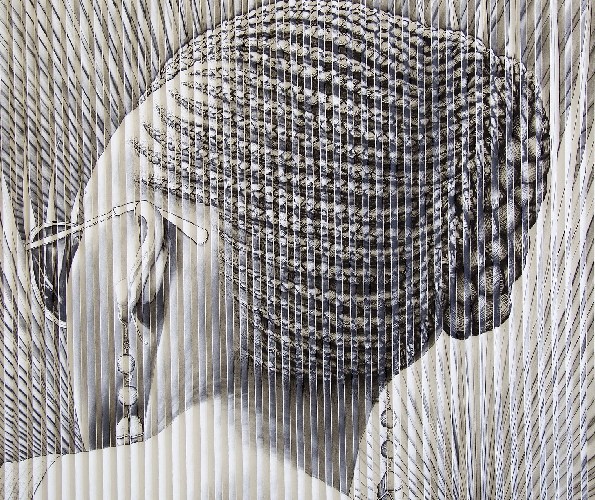
It was the effort they put into their hair care that intrigued Stephens the most. Inspired by people standing in grocery lines, crowds at soccer games and people crossing the streets, he began a series of drawings that depicted their braided hairstyles in remarkable detail.

He views his work as a process of documenting and paying homage to those who inspire him, and although it is not necessarily about drawing conclusions, he does agree that how a person wears his or her hair in Africa immediately gives an impression of that person’s identity. But more than that, Stephens’ intention is to try to elevate the everyday; making it monumental by painstakingly paying attention to detail and pattern in his art.

When one looks at his work his vision definitely takes shape. Staring into each intricately detailed, interwoven strand of hair opens up a strange and mysterious new world that, at the same time, is somewhat familiar, oddly normal and breathtakingly beautiful.

Stephens maintains that part of an artist’s role is to see beauty, reflect it back to society and raise attention around it. Through his work he hopes to help people experience the beauty they stopped noticing or previously overlooked and allow them to appreciate what they have missed because it is so ‘everyday’.

His message is loud and clear; everyday events and what we regard as “normal” are often extraordinary, if one just takes a little time to have a closer look.

We are constantly surrounded by miracles, but often fail to see them because they exist in ordinary things and daily occurrences. But imagine, if like Gary Stephens, we were all inspired by the ‘common’ things around us? Imagine if we took a little time and had the perspective to find beauty in the supposedly mundane? Then wouldn’t everything be ‘sharp’?

Sometimes conspicuous beauty can become futile, sometimes inconspicuous beauty can take our breath away, sometimes we can overlook beautiful things because we become used to them. Sometimes we need to take a moment to smell the roses and sometimes we need to meet people like Gary Stephens to awaken us to all that is beautiful.

The Stoned Cherrie of Joburg's Heart

The ‘Stoned Cherrie” of Joburg’s heart

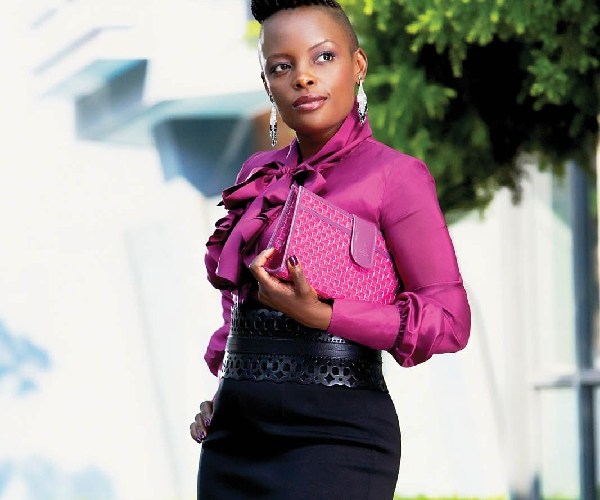
On the corner of 11th and Lillian, in Johannesburg’s Parkmore suburb, stands a striking olive house, mysterious and alluring. Upon entering it, my eyes are greeted by a burst of color, the backdrop to a space clad in vintage furniture, inspiration boards and collections of accolades. Eclectic fabrics are piled high in a small factory to the side – it’s any artist’s dream workspace. While I sip my cup of tea (so fittingly offered), I’m met by a pint-sized figurine’s warm welcome. “Hi I’m Nkhensani”. I am momentarily transfixed, Nkhensani is immaculately dressed, sporting her signature twisted hairdo with subtle make-up accentuating her glowing skin. Her entire being exudes a youthful glow. Looking not a day over 28, her 40th birthday is around the corner.

Clearly longevity is no stranger to this woman who took a leap of faith 13 years ago and launched Africa’s much-loved fashion brand, Stoned Cherrie. Today I have the chance to speak to her about the brand and to tap into the topic of identity; her identity, the identity of Stoned Cherrie and that of Johannesburg and its fashion scene.

“I wouldn’t say that my identity has evolved with the growth of the brand. I would say that it is what it is. I think I have always had a strong sense of identity. I grew up during the most turbulent time in our history so naturally the socio-political and economic issues have had a big role in defining who I am. I think that the things that have changed through the years are a result of me maturing. My identity remains the same but now I have a stronger need for introspection”.

“As for the Stoned Cherrie woman’s identity; she is a free-spirited individual with a strong sense of identity and pride and a spirit of resilience. She has worldly views, but intrinsic African values – a strong sense of loyalty to the continent with a modern definition of what it means to be African. Her identity molds perfectly into the identity of Johannesburg and the city’s fashion landscape, undefinable, limitless, one thing today, something else tomorrow”.

Indeed, Nkhensani’s experience of Joburg fashion is true – it’s undefinable and constantly changing. In the past 13 years, since the birth of Stoned Cherrie, the Johannesburg fashion landscape has seen the launch of numerous luxury designers and brands such as David Tlale, Suzan Heyns and Thula Sindi. It has also seen the birth of local fashion weeks inspired by the likes of New York and Paris fashion Week and a massive vintage boom fueled by the re-generation of the inner-city.

“I think it has evolved in the sense that we definitely have a stronger sense of identity and a huge appreciation for proposals of negotiating a new identity. So, there is a lot more expression that, at the same time has always been there. If you look at the townships for example, people have been dressing up forever, it’s just that it wasn’t mainstream and a lot of it was fashion from other parts of the world. I think we ushered in a new era that was about celebrating local designs. So, there’s definitely a lot more expression and a lot more play in the market which is great because that’s how you build an industry.”

Nkhensani’s stance is firm when she indicates that as much growth as there has been, the journey has only just begun and bigger players need to invest in the industry.

“Having few players in the market is not an industry, in an industry there is trade. I think ours is a burgeoning industry barely at its infancy. You have a proper industry when you have big business investing and creating distribution channels – because at the end of the day it’s all about distribution. That’s why the luxury industries of international territories continue to grow on a global level, because they have massive machines behind them – it’s the only way to grow the industry. We are not there yet, but hopefully that will soon change.”

There is no other place she would rather be helping to build that industry than in Johannesburg, a city that constantly inspires her work.

“We have a new collection, the Jozi Maboneng, which is clearly influenced by the Joburg skyline because it’s a snapshot of urban imagery. For me when I talk about urban imagery, I remember the Joburg skyline when I used to travel from the city to Soweto, it was always at dusk when the sun was starting to set. Even today I end up yearning for that picture – the unpredictability it presents and that fine line between hard and soft, safe and unsafe.”

Nkhesani alludes to other passions which go beyond the ‘needle-and-thread’ image we normally associate with her.

“Ceramics are an absolute passion of mine. I created the Stoned Cherrie ceramic tea-set out of my love for the ceramic creative process and my love for tea. The tea experience is a very intimate moment for me. I like to refer to it as my ‘comfort thing’. I love peppermint tea a lot because it’s good for digestion and I absolutely love ginger. A cup of tea can solve any problem”.

Problems and moments of crisis are nothing new to the designer who insists that they are simply a reality.

“You need to know that if you are going to become an entrepreneur, you need to have a problem-solving attitude, I always use challenges as opportunities to learn something new.”

Something new that I learned from my conversation with Nkhensani is that not all designers design for the love of clothes, they simply relish in the beauty around them.

“I’m not passionate about fashion. I’m passionate about how beautiful, hand-crafted garments make a person feel.”