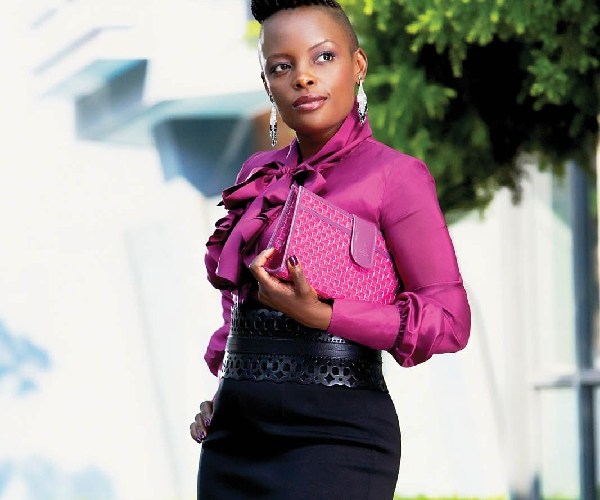
On the corner of 11th and Lillian, in Johannesburg’s Parkmore suburb, stands a striking olive house, mysterious and alluring. Upon entering it, my eyes are greeted by a burst of color, the backdrop to a space clad in vintage furniture, inspiration boards and collections of accolades. Eclectic fabrics are piled high in a small factory to the side – it’s any artist’s dream workspace. While I sip my cup of tea (so fittingly offered), I’m met by a pint-sized figurine’s warm welcome. “Hi I’m Nkhensani”. I am momentarily transfixed, Nkhensani is immaculately dressed, sporting her signature twisted hairdo with subtle make-up accentuating her glowing skin. Her entire being exudes a youthful glow. Looking not a day over 28, her 40th birthday is around the corner.
Clearly longevity is no stranger to this woman who took a leap of faith 13 years ago and launched Africa’s much-loved fashion brand, Stoned Cherrie. Today I have the chance to speak to her about the brand and to tap into the topic of identity; her identity, the identity of Stoned Cherrie and that of Johannesburg and its fashion scene.
“I wouldn’t say that my identity has evolved with the growth of the brand. I would say that it is what it is. I think I have always had a strong sense of identity. I grew up during the most turbulent time in our history so naturally the socio-political and economic issues have had a big role in defining who I am. I think that the things that have changed through the years are a result of me maturing. My identity remains the same but now I have a stronger need for introspection”.
“As for the Stoned Cherrie woman’s identity; she is a free-spirited individual with a strong sense of identity and pride and a spirit of resilience. She has worldly views, but intrinsic African values – a strong sense of loyalty to the continent with a modern definition of what it means to be African. Her identity molds perfectly into the identity of Johannesburg and the city’s fashion landscape, undefinable, limitless, one thing today, something else tomorrow”.
Indeed, Nkhensani’s experience of Joburg fashion is true – it’s undefinable and constantly changing. In the past 13 years, since the birth of Stoned Cherrie, the Johannesburg fashion landscape has seen the launch of numerous luxury designers and brands such as David Tlale, Suzan Heyns and Thula Sindi. It has also seen the birth of local fashion weeks inspired by the likes of New York and Paris fashion Week and a massive vintage boom fueled by the re-generation of the inner-city.
“I think it has evolved in the sense that we definitely have a stronger sense of identity and a huge appreciation for proposals of negotiating a new identity. So, there is a lot more expression that, at the same time has always been there. If you look at the townships for example, people have been dressing up forever, it’s just that it wasn’t mainstream and a lot of it was fashion from other parts of the world. I think we ushered in a new era that was about celebrating local designs. So, there’s definitely a lot more expression and a lot more play in the market which is great because that’s how you build an industry.”
Nkhensani’s stance is firm when she indicates that as much growth as there has been, the journey has only just begun and bigger players need to invest in the industry.
“Having few players in the market is not an industry, in an industry there is trade. I think ours is a burgeoning industry barely at its infancy. You have a proper industry when you have big business investing and creating distribution channels – because at the end of the day it’s all about distribution. That’s why the luxury industries of international territories continue to grow on a global level, because they have massive machines behind them – it’s the only way to grow the industry. We are not there yet, but hopefully that will soon change.”
There is no other place she would rather be helping to build that industry than in Johannesburg, a city that constantly inspires her work.
“We have a new collection, the Jozi Maboneng, which is clearly influenced by the Joburg skyline because it’s a snapshot of urban imagery. For me when I talk about urban imagery, I remember the Joburg skyline when I used to travel from the city to Soweto, it was always at dusk when the sun was starting to set. Even today I end up yearning for that picture – the unpredictability it presents and that fine line between hard and soft, safe and unsafe.”
Nkhesani alludes to other passions which go beyond the ‘needle-and-thread’ image we normally associate with her.
“Ceramics are an absolute passion of mine. I created the Stoned Cherrie ceramic tea-set out of my love for the ceramic creative process and my love for tea. The tea experience is a very intimate moment for me. I like to refer to it as my ‘comfort thing’. I love peppermint tea a lot because it’s good for digestion and I absolutely love ginger. A cup of tea can solve any problem”.
Problems and moments of crisis are nothing new to the designer who insists that they are simply a reality.
“You need to know that if you are going to become an entrepreneur, you need to have a problem-solving attitude, I always use challenges as opportunities to learn something new.”
Something new that I learned from my conversation with Nkhensani is that not all designers design for the love of clothes, they simply relish in the beauty around them.
“I’m not passionate about fashion. I’m passionate about how beautiful, hand-crafted garments make a person feel.”
 KIM LEE MORTON